Electoral reform gets people of substance and independent mind into Parliament. This page asks how Government should work once they are there.
The problem: too much power in too few hands
Under our Westminster system there is little real separation between those who make the laws, those who carry them out, and those who appoint the judges. Power is concentrated, often in people who are not equipped to wield it.
- Ministers are given two jobs. An elected member is expected to represent constituents full-time and also run a department worth billions of dollars. No one can do both well.
- The public service rewards caution. Senior public servants too often rise to the top by being safe team players rather than by merit or bold ideas. ROAD contends that no political party should have a standing advantage inside the machinery of government, and that union membership within the public service compromises its neutrality.
- The Senate no longer reviews. Since above the line voting began in 1984, no ungrouped (truly independent) candidate has been elected to the Senate. When the same parties dominate both Houses, legislation is waved through without serious scrutiny.
- The Attorney-General wears too many hats. The Attorney-General is a member of Parliament and of Cabinet, and also advises on the appointment of the judges who rule on the Government's own laws.
None of this was deliberately designed. It evolved, and it no longer serves Australians well.
Guiding principles
- Government should be as close as possible to the people it serves.
- Government should facilitate, and regulate only as a last resort.
- No one can serve two masters: representing constituents and running a department are incompatible roles.
- Making law should be demanding, so that only truly important things become law. Nearly every law costs the citizen some liberty.
- The branches of Government should be co-equal, so that each keeps the others in check.
How Government should work
ROAD proposes a clear division of labour:
- Parliament decides and pays. Parliament makes the laws, sets the goals and provides the money. It can withdraw funding from any department that is not carrying out its will.
- The Cabinet oversees. Cabinet works like a board of directors, with the Prime Minister as its chairman, not its boss. Each minister watches over a portfolio, reports to Parliament on whether the department is doing what Parliament wants, and brings back ideas for doing it better. Ministers do not run departments.
- The Governor manages. The Governor, or Governor-General, is responsible for the public service and for carrying out Parliament's will while obtaining maximum value for the money spent. The Governor chooses department heads and their deputies on merit, from anywhere in the world, and decides which departments are needed.
- Advice, not orders. The Prime Minister, Cabinet and department heads form an Executive Advisory Council. They tell the Governor what Parliament wants achieved; they cannot tell the Governor how to do it. The Prime Minister's duty is to represent the Cabinet's view faithfully, not to decide alone. The Cabinet's duty is to represent the will of Parliament faithfully.
This is less radical than it sounds. Our Constitution already vests executive power in the Crown, exercised by the Governor-General and advised by the Federal Executive Council (sections 61 and 62). It is convention, not the written text, that has turned the Prime Minister into "the boss". Switzerland shows that a government without a single boss can work: its seven-member Federal Council governs collectively, and its president is only the first among equals.
Elected, independent office-holders
- Elect the Governors and the Governor-General. Parliament should have no say in who holds these offices. Every candidate must be at least 35 years of age, and must never have been a member of any Parliament or of the legal profession.
- Elect the Attorneys-General. The same conditions apply. No one should oversee a system they belong to, or one in which their friends hold office. The role is like that of a jury: an independent citizen's judgement.
- An Upper House of independents. Upper House candidates must leave any political party or politically aligned organisation before they stand, so that the Upper House can be a true house of review.
- One job for members of Parliament. Their sole responsibility is to represent their constituents faithfully.
Three co-equal branches, and a neutral guardian
The result is three co-equal branches: the Legislature (both Houses of Parliament), the Judiciary (the Attorney-General and the courts) and the Executive (the Governor-General, the public service and the Defence Force). Because they are co-equal, none can hold reserve powers to dismiss another. The Governor-General would no longer dissolve Parliament; that is a relic of monarchy.
History shows that executives, politicians and judges cannot be trusted to police themselves. ROAD therefore proposes a small Constitutional Council, elected directly by the people, in whose selection Parliament has no part. It has no power to compel anyone. It:
- oversees the Electoral Commissions and the Electoral Act, measured against the electoral ideal stated in the Constitution;
- refers misconduct by anyone in the three branches, including judges, to Parliament, and makes it public;
- acts as a neutral go-between in disputes between the branches, and gives the people an unbiased account; and
- recommends a referendum or binding plebiscite where a remedy is needed.
Unlike some constitutional courts overseas, it cannot strike down laws. A body with no power cannot itself become a tyranny. It advises, publicises, refers and recommends. The people decide.
Questions for the Convention
Some questions are too important for any one person to answer. Here is one possible answer to each, offered as a starting point for debate.
How do we keep the Council neutral?
The Council has no power, only credibility, so it is worthless if seen as partisan. One answer: members are elected as independents, serve a single fixed term, and are barred for life from standing for, or being appointed to, any other public office.
Who hears an impeachment?
The Council can refer a matter but cannot judge it. One answer: the Lower House decides whether to impeach, and the Upper House, made up entirely of independents, tries the case. If Parliament will not act, the electors decide at the ballot box.
What if Parliament will not pass supply?
In 1975 the Senate deferred the Appropriation Bills and the Government was dismissed. With a separately elected Executive there is no confidence vote to fall back on. One answer: if new appropriations have not passed by the start of the financial year, the previous year's continue automatically until they do. Parliament can still contest new spending, but no one can starve the Government.
Who commands the forces if Government breaks down?
Giving command to any person or body risks legitimising a seizure of power. One answer is that the Constitution itself gives the order. It defines the triggers, such as an Executive refusing to leave office after losing an election. The Council and the Chief Justice must jointly certify that a trigger has occurred. The forces then do one thing only: protect the poll and the count, while the Electoral Commissions hold an election within three to four weeks.
A radically different model
Australia's six States, two Territories and Federal Government were never designed; they grew out of colonial expediency. ROAD's predecessor, the Foundation for National Renewal, proposed a different approach that disperses power closer to the people:
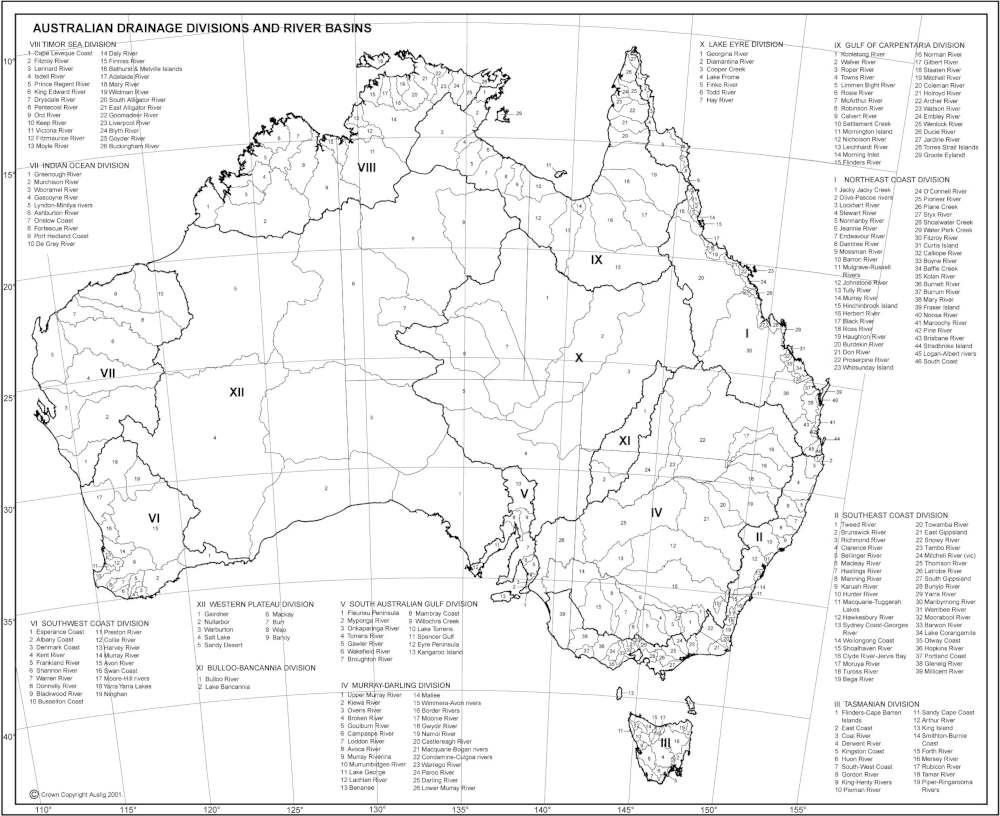
- divide Australia into Regions, bounded by ridgelines rather than rivers, so that each Region is a natural community;
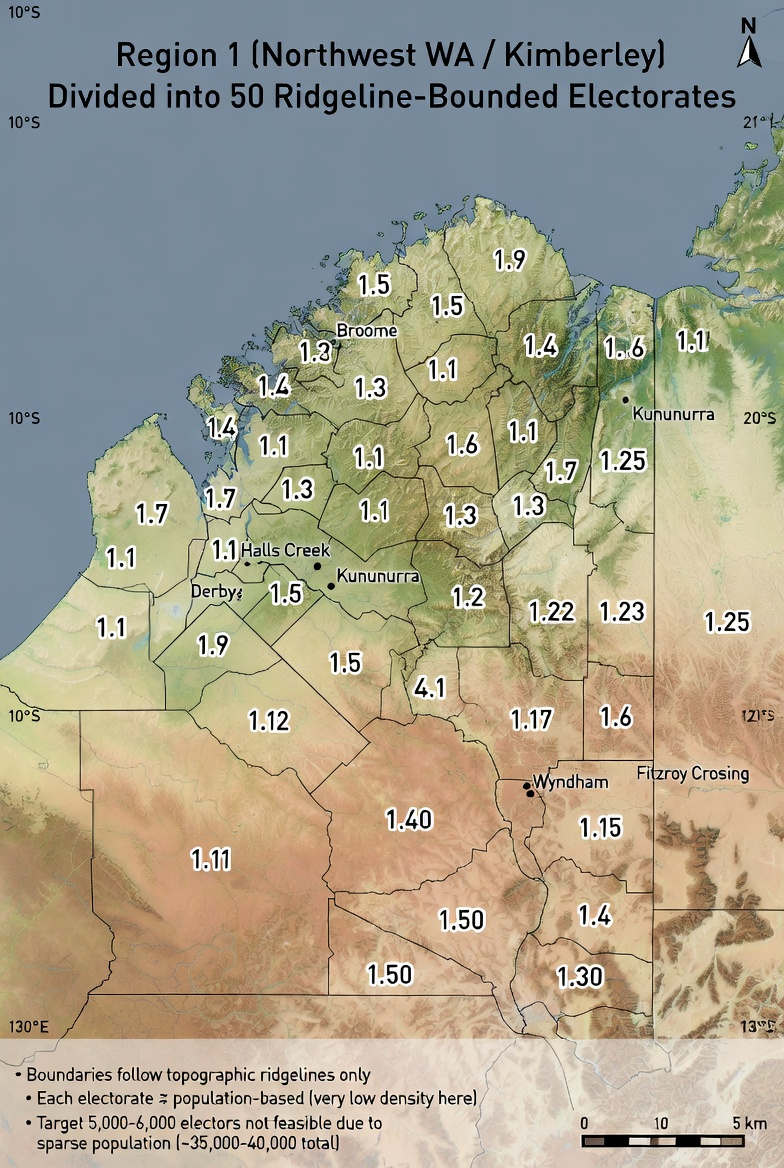
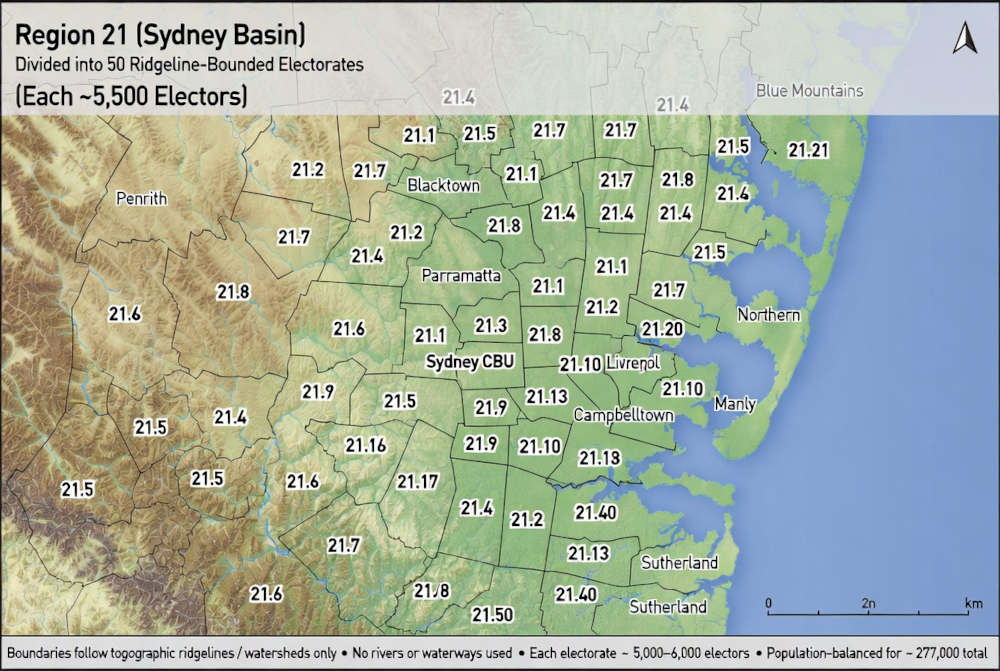
- divide each Region into 50 electorates of 5,000 to 7,000 electors, each electing one member of a Regional Assembly;
- elect one person per Region to a Federal Parliament, a Chief Executive and an Attorney-General for each Region, and a national Chief Executive and Attorney-General; and
- require that no Federal Bill passes without the agreement of a majority of Regions, a truly bicameral system.
The Foundation proposed 96 Regions. On today's roll of about 18.4 million electors, about 70 Regions would put each electorate near 5,000 electors, with population growth carrying them towards 7,000 over the following decades. Either way, there would be fewer elected positions than the roughly 6,300 we have today across local, State, Territory and Federal government, and electors would be far more likely to know their representative personally.
An experiment using AI
To test whether ridgeline Regions are practical, ROAD's founder asked an AI tool to divide Australia into 100 Regions of 50 electorates each, bounded by ridgelines rather than rivers. The maps below are its first attempt. They are rough, and they were based on population rather than electors, which is why the number of Regions needs refining. But they show that the idea can be mapped.
The more you look at this idea, the more sensible it becomes. At the very least, it is food for thought.