
Our present preferential count looks at your first choice, and at your later preferences only when the candidates above them are eliminated. A candidate whom most voters rank highly, but few rank first, can be knocked out in the first round and never counted again.
ROAD proposes a simpler count that weighs every preference on every ballot at once: the Borda Count. It is reform 13 of ROAD's electoral reforms, and the last step towards our goal: the electorate's preference, precisely measured.
How it works
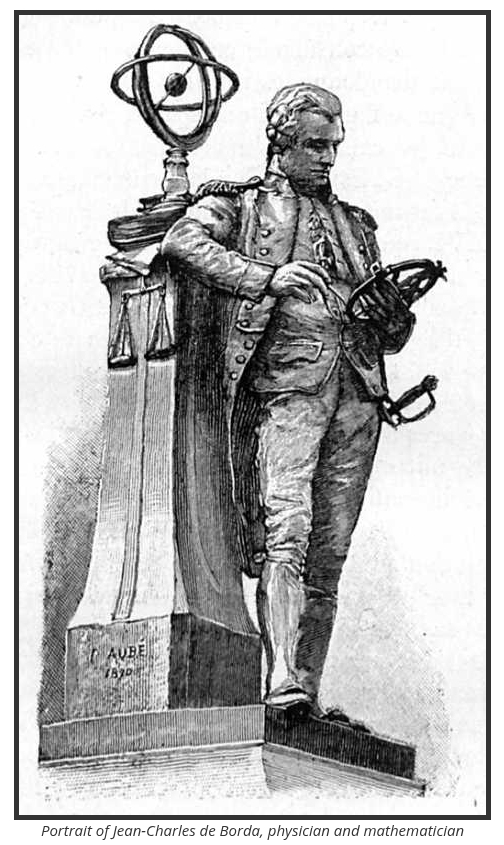
The system was devised in 1770 by Jean-Charles de Borda, a French mathematician and naval officer. You rank every candidate, using each number once. Each rank earns points:
Points = (number of candidates + 1) minus the rank given.
With five candidates, a 1st preference earns 5 points, a 2nd earns 4, and so on down to 1 point for a 5th. The candidate with the most points wins. There are no elimination rounds and no preferences left uncounted, and the count is fast and well suited to machine tallying checked by scrutineers.
A completed ballot might look like this:
| Candidate | Your ranking | Points | ||||
|---|---|---|---|---|---|---|
| Candidate 1 | 1 | 2 | 3 | 4 | 5 | 3 |
| Candidate 2 | 1 | 2 | 3 | 4 | 5 | 4 |
| Candidate 3 | 1 | 2 | 3 | 4 | 5 | 1 |
| Candidate 4 | 1 | 2 | 3 | 4 | 5 | 2 |
| Candidate 5 | 1 | 2 | 3 | 4 | 5 | 5 |
A worked example
Here are 101,000 voters choosing between five candidates. Each figure is the number of voters who gave that candidate that rank.
| Candidate | 1st | 2nd | 3rd | 4th | 5th | Points | Place |
|---|---|---|---|---|---|---|---|
| Candidate 1 | 30,000 | 8,600 | 5,000 | 30,000 | 27,400 | 286,800 | 4 |
| Candidate 2 | 32,000 | 3,200 | 15,500 | 20,000 | 30,300 | 289,600 | 3 |
| Candidate 3 | 17,000 | 13,000 | 20,500 | 25,900 | 24,600 | 274,900 | 5 |
| Candidate 4 | 12,000 | 16,000 | 40,000 | 15,200 | 17,800 | 292,200 | 2 |
| Candidate 5 | 10,000 | 60,200 | 20,000 | 9,900 | 900 | 371,500 | 1 |
Candidate 2 has the most first preferences. Candidate 5 has the fewest, and under our present count would be the first eliminated. Yet 60,200 voters ranked Candidate 5 second, and fewer than 1 in 100 ranked Candidate 5 last. The electorate is saying, "If we can't have our first choice, this is the person we want!".
Under Borda, Candidate 5 wins clearly. Candidate 2, the first-preference leader, comes third.
Try it yourself
Enter how many voters gave each candidate each rank, or load the example above and change the figures to see what happens.
Fair questions, and ROAD's answers
Can voters game it?
Voters could rank their favourite’s strongest rival last to drag that rival down, a tactic known as “burying”. It is a real risk, but no ranked voting system is free of tactics. In the 1970s, the philosopher Allan Gibbard and the economist Mark Satterthwaite proved that every such system with three or more candidates can be gamed. Our present system is no exception. Campaigns urging voters to rank tactically, such as calls to “put the majors last”, are familiar at every election. Under the Senate’s former group voting tickets, organised preference deals between minor parties saw candidates elected on tiny primary votes, one with about half of one per cent. That was possible only because parties, not voters, decided where preferences flowed, which is precisely what ROAD proposes to end.
Burying is also a gamble. If many voters push a strong rival down, a third candidate can come through the middle.
ROAD's other reforms make organised tactics much harder. With candidates rotated on the ballot, no party names or logos, and no how-to-vote cards or campaigning on election day, there is little opportunity to coordinate a buried vote on polling day.
Can a candidate with a majority lose?
Yes. A candidate ranked first by 51 per cent of voters and last by the other 49 per cent can lose to a candidate whom almost everyone ranks highly. ROAD contends that is the better result because a representative must serve the whole electorate, not just the half that voted for them. If the Convention disagrees, a simple safeguard is available. Should that be the case, a candidate with an outright majority of first preferences is elected automatically.
Could parties flood the ballot?
A party could run several similar candidates so that, between them, they push rivals down the rankings. ROAD's answer is that candidates should stand as individuals on their own merits, with no party ordering and no party names on the ballot. Nomination rules that stop a party from flooding the field are a matter for the Convention.
What about the Senate?
The Borda Count picks a single winner. It can fill several seats by electing the candidates with the most points, as Nauru does for its multi-member electorates using a Borda variant. That approach is simple, but a large, cohesive bloc of voters could win most of the seats, and asking voters to rank a hundred or more Senate candidates is a heavy burden. Proportional versions of Borda exist.
Under ROAD's alternative model, in which each Region elects one representative to a Federal Parliament, the Borda Count applies directly. How the Upper House should be counted is one of the questions ROAD puts to the Convention.